I ate at The Counter and had a fantastic burger and gained no weight–how come?

I had a large delicious burger.  It was so good!  You don’t have to starve on a diet.  When you aren’t on maintenance like I am, you might have to eat 2/3 of what I ate, but you can still eat it.  That is the cool part!

So, here is a picture of my burger.

burger


So, let’s look at the carbs of my choices.  I gave up eating 40g of carbs by having my burger as a salad and not in a bun!


–My burger had NO carbs, and had a lot of protein.

–cheese had less than 1 carb.

–My couple of slices of tomatoes had maybe 1 g of carbs.

— My pickles had about 1 g of carbs.

–The lettuce had about 2g per cup and I had about 2 cups.  So, lettuce=4g of carbs.

Here is the hairy part.  

–You have to be so careful what you get.  I ordered sautéed onions.  This could be a problem.  If you look online at thecounterburger.com and look up their nutritional information, you will see that the whole plate worth is about 9g of carbs.  But, I only ate half.  So, 4.5 for me!

–I had the Dijon balsamic vinaigrette, but I only had half, so instead of 15,  I had maybe 10g of carbs.

I ate this whole thing and only had about 21g of carbs, which is really good for a larger meal.  I had to think carefully when ordering.  I tasted someone’s cookie and probably had another carb, but I did not have a dessert there.  I waited until later for Carbolite as my last protein of the day out of 6 and consumed 15g of carbs with that.  As long as I am between 50 and 100g of carbs a day (the closer to 50, the better), I am ok.

So you can have good food on a diet, just select carefully.  If I had the honey mustard  or ranch dressing, I could have sliced off another 5g of carbs.

So, eat, but choose wisely.


Christmas Eve and all of its Goodies

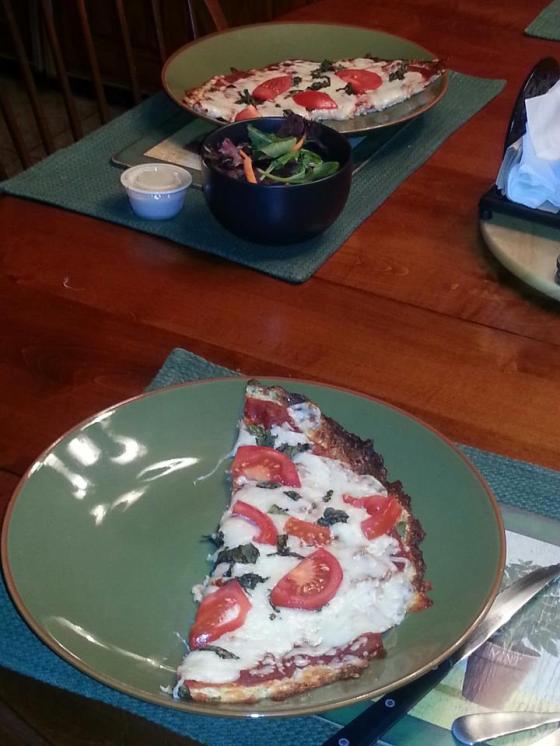
Tonight, my husband and I wanted a quiet dinner alone.  I made us a delicious cauliflower-based pizza (we shared a 10 inch pizza) and had some salad.  I made two, so there are leftovers.

pizzanightDinner was delish.  I have Carbolite for dessert (low carb, sugar-free ice cream).  My tummy is happy and I will have had low enough carbs NOT to gain weight.

I have friends who are having Chicken or Turkey dinners and that is great, as long as they stick to vegetables, salad and try to skip the pies.  You can have a bite, maybe two.  But, the sugar is not good for you and if you want to lose weight or MAINTAIN, unless you had no carbs all day, you can’t afford to have so many in one go.  A slice has about 40g of carbs and Costco pie has 47g (they are always more carbilicious).  There is 37g of sugar in a Costco pumpkin pie slice.  That is about 9 sugar cubes.  Apple pie has about 57g of carbs in a slice.

If you want to lose weight, you want close to 50g of carbs a day and up to 100g.  If you want to maintain, you don’t want to go over 100g of carbs.  If a slice of pie is HALF of your day’s carbs, what will happen if you eat your yams, potatoes, bread and other carbs too?  And have a small plate of food, but please don’t get seconds!

So, eat your proteins, fibers, veggies, fruit (to a limit) and watch those carbs.  You can do it.  And exercise if you mess up!  Go for a walk today or tomorrow–or both.


Happy Holidays from Skinny-Rules!


Why Eggs are Eggscellent for a Diet

Eggs Are a Weight-Loss Superfood with Health Benefits

Hard-Boiled-Eggs

Eggs!  They can be eaten for breakfast, lunch or dinner–or as a snack.  They can be boiled, fried, poached, scrambled over easy or hard, deviled, etc.

They are low-calorie (80 per egg), low carb (less than 1g carb per egg) and high protein (6g per egg).   Eggs are an excellent snack or meal for anyone who wants to lose or manage their weight.  I hard-boil or buy hard-boiled ones and pop one or two in my mouth as I run out the door in the mornin. Add a handful of fresh spinach to an egg scramble, and you have a healthy breakfast that’s bursting with nutrients. Egg whites have only 15 calories per egg, no cholesterol, and no saturated fat, which makes them extremely diet-friendly.

In addition to helping with weight control, eggs supply many essential nutrients, including vitamin A, and the minerals iron, phosphorus, zinc, and DHA, which is a key to brain health. For vegetarians who still eat some animal products, eggs are an excellent nonmeat source of the vitamin B12, an essential nutrient that most humans get from meat, fish, and dairy.

How nutritious an egg is also largely depends on how it was produced. Some farmers now feed laying hens omega-3-rich diets that in turn produce eggs that are enriched with Omega-3 fatty acids,  which can boost heart and brain health.

Most of egg’s bad reputation is due to the yolk’s cholesterol. According to the American Heart Association, one large egg yolk has about 186 milligrams (mg) of cholesterol, and it’s recommended that the average person limit dietary cholesterol intake to 300 mg per day. The AHA recommends that people with normal cholesterol levels cap their egg consumption to four or fewer whole eggs per week, and suggests that people with heart disease eat two or fewer eggs per week or use cholesterol-free egg substitutes. Because egg whites contain no cholesterol, unlimited egg white consumption is perfectly heart-healthy.

The reputation of eggs has largely been restored because study after study has found that dietary cholesterol has a much smaller impact on cholesterol levels than was once believed. In fact, a 2001 study published in Circulation, the journal of the American Heart Association, found that lutein, a nutrient found in egg yolks, may even help reduce the risk of heart disease.

Egg Substitutes

eggbeaters

Most egg substitutes, such as Egg Beaters, are pasteurized egg whites that are supplemented with beta-carotene for color and additional vitamins. There are also animal-free egg substitutes on the market that are made from potato starch or yeast flakes, which when mixed with water, can resemble the consistency of beaten eggs.

Diet / Binging

Diet deprivation, especially in the beginning stages of weight loss can cause someone to crave the foods that you have cut out.

diettemptation

Binging simply means you have temporarily lost control over the amount and type of food you planned to eat.  I have seen this so many times.  You are doing fine and then someone brings in cupcakes, brownies, etc.  You break down and have some and before you know it, you do it more and more. Here’s what you can do to help protect your weight loss plan.

Even occasional binging adds unwanted calories to your diet. The key to weight-loss success is to be aware of your weaknesses and actually make room for them in your diet.

“I don’t think you should give up everything. That’s the key. You can budget in a sweet item every day or else I would really be crabby.  For me, having my Nature Valley Protein Dark Chocolate Peanut Butter bar, Power Crunch or my Carbolite helps get me through those moments.  They all have protein and low carbs vs. a plain chocolate bar or regular ice cream or frozen yogurt, laden in gobs of sugar and carbs and little protein.  I add the carbs in my choices into my 50 to 100g of carbs per day.

Smart dieters (way of life for me now through maintenance) find ways to adapt this strategy to their diet plan and achieve the right balance of calories. You can also have a end up having a sliver of what you are craving, and if you are dedicated during the week, then make it your one cheat day. The cheat day isn’t a binge, but more of a maintenance day — no calorie reduction, but no excess calories taken in either.

Another balancing option is to avoid temptation entirely when you’re at home, and have strategies for when you eat out. In other words, simply don’t buy food that will sabotage your weight-loss strategy.  Have healthy snack options at home.  I have protein bars, Greek yogurt, nuts, cheese, meet choices, veggies and fruit.

One approach is to  find “calorie bargains” that are similar to the treats you crave. Look for healthier alternatives or “light” versions of favorite snacks. But be sure to read food labels carefully — some reduced-fat treats have more added sugar and are not lower in calories.  Be careful though on carb counts.

Even though the occasional binge adds calories to your day and is a threat to your weight-loss goals, it isn’t usually unhealthy. However, when binging becomes a way of life, it may signal an eating disorder that requires professional help to overcome:

  • Binge-eating disorder is when you binge frequently and feel shame or embarrassment, but cannot stop doing it. People with this disorder are often overweight or obese. Because it is associated with anxiety and depression, it can be treated with some antidepressants.
  • Bulimia nervosa is when you binge and then try to “purge” or get rid of the calories by vomiting, taking laxatives, fasting, or exercising to an extreme. People with bulimia often appear to be of normal weight, but are obsessed with weight gain or loss, unhappy with their body, and ashamed of their binging and purging.

These eating disorders are more common in women, but can also be a problem for men and boys. If you are binging frequently and feel anxious or ashamed, seek help from your doctor.

For the occasional binger who wants to stop the overeating-dieting cycle, you should be able to avoid binging by budgeting calories/carbs to include the treats you love. When you find a way to balance these calorie-dense foods with better nutritional choices, you won’t be as tempted to overindulge.

Junk Food=Junk Brain (leads to anxiety/depression)

Eating junk food can actually change the brain, spurring symptoms of anxiety and depression if you stop consuming it, according to a new study in mice.


junk_food_1

Researchers from the University of Montreal found that mice fed diets high in sugar and fat had different chemical activity in their brains and exhibited more signs of withdrawal if they stopped eating it, compared with those fed more healthy foods.

“The chemicals changed by the diet are associated with depression,” study researcher Dr. Stephanie Fulton said in a statement. “A change of diet then causes withdrawal symptoms and a greater sensitivity to stressful situations, launching a vicious cycle of poor eating.”

They found that the mice fed the high-fat diet were more anxious at the end of the study, and also had higher levels of the CREB molecule, which is known to play a role in dopamine production (dopamine helps promote feelings of reward).  They also gained weight and the changes in the brain occured before obesity.

This is certainly not the first time junk food has been linked to negative effects in the brain. A Neurology study published last year showed a relationship between having high blood amounts of trans fats anddecreased performance on brain functioning tests, as well as decreased brain volume.

“It’s clear that trans fats are bad — both for your heart and now, we see, for your brain,” the researcher of that study, Dr. Gene Bowman, of Oregon Health & Science University, told HuffPost Food.

It is recommended that people stay away from all trans fats. If  there’s vegetable shortening, partially hydrogenated anything… just put it down.  You will have some withdrawal, but let it pass and eat healthy food and avoid future issues with messing with your brain chemistry.

donuts


 http://www.huffingtonpost.com/2012/12/12/fat-food-brain-chemical-changes-depression-withdrawal_n_2287880.html?ncid=edlinkusaolp00000003


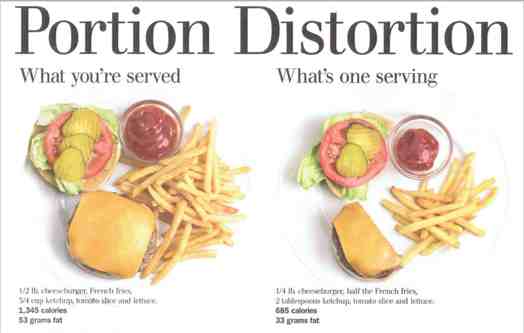
Portion Distortion

How to Estimate Portion Sizes for a Low-Carb Diet

portion

A low-carb diet relies on knowing portion sizes to help you eat the proper quantities of the proper foods.  Some people eat healthy food, but do not watch their portion size  and then wonder why they aren’t losing weight.  To determine the number of low-carb servings you’re eating, you need to estimate portion sizes. You may be surprised to see that normal portion sizes are a lot smaller than you think, as the comparisons in the following table show:

Measurement Size
1/2 cup About the size of a cupcake wrapper
1 cup About the size of a tight fist or a tennis ball
1 medium fruit About the size of a tight fist or tennis ball
1 medium potato About the size of a computer mouse
1 ounce cheese About the size of your thumb or a pair of dice
3 ounces meat About the size of the palm of a woman’s hand or a deck of cards
2 tablespoons reduced-fat salad dressing About the size of a Ping-Pong ball
1 teaspoon oil or butter About the size of the tip of a thumb

portion-control-297x300

Remember:  6 proteins a day, spaced out 3-4 hours.  Two veggies (approx 1 cup each)  a day, two fruits (1/2 cup each) a day, 2 cups of lettuce at lunch and 2 cups at dinner.  I have a salad with veggies and protein for lunch and dinner and it fills me and it kills a lot of birds with one stone.

salad

the KETOGENIC DIET: Turns out that a low-carb diet makes you thin AND delays the AGING PROCESS

eggsbacon

Reducing calories and eating low-carb foods, something scientists at the Gladstone Institutes call the Ketogenic Diet, could delay the aging process. According to a study headed up by Gladstone Senior Investigator Eric Verdin, MD, the development of this anti-aging ketogenic diet could help to eventually combat age-related diseases such as heart disease, cancer, and certain forms of mental deterioration.

http://www.sciencemag.org/content/early/2012/12/05/science.1227166.abstract

lowcarbzone

“Over the years, studies have found that restricting calories slows aging and increases longevity—however the mechanism of this effect has remained elusive,” Verdin said in a statement. “Here, we find that βOHB—the body’s major source of energy during exercise or fasting—blocks a class of enzymes that would otherwise promote oxidative stress, thus protecting cells from aging.”
Read more: http://www.voxxi.com/ketogenic-diet-low-carb-low-calorie/#ixzz2EswKVfaQ

How to Eat the Low-Carb Way

How to Eat the Low-Carb Way

Eating the low-carb way means building your diet around lean proteins along with vegetables and fruits prepared fairly simply. If you were a meat-and-potatoes eater, focus on the meat more than the carb-heavy potatoes. The tips in the following list offer advice on what foods to choose:

1. Build your meals around lean protein, fruits, vegetables.

2. Choose whole grains or legumes for your daily carb choices. Minimize your intake of processed foods. Personally, I say you are better off trying to exclude whole grains, except for one or two per week, in place of a fruit.

3. Choose very low-fat milk and dairy foods. Check carb content. There are some Greek yogurts with 8g of carbs per container, and there are some with 20g of carbs for the same sized container.

4. Choose monounsaturated rather than saturated fats. http://www.mayoclinic.com/health/fat/NU00262

5. Eat 6 small proteins a day (approximately 4 ounces of meat. Egg, protein drink or bar, etc.) and salads twice a day along with small amounts of fruits and vegetables 2 times per day. Never starve yourself and never skip meals. If you eat between meals, eat healthy foods that are also filling, like salad, fruit, vegetables, milk product like yogurt, low-carb ice cream, or cheese, or a handful of nuts.

6. Do not eat a full meal right before bedtime. A bedtime snack such as nonfat yogurt or cottage cheese and a cup of fruit or less is okay.

7. Drink plenty of water — eight glasses a day

8. Exercise moderately 30 to 60 minutes at least five times a week.

9. Allow a cheat only one to two times a week, max.

20121209-185055.jpg

Holiday Food Time Again and Low-Carb RECIPES!

So many people I know tell me that they are going to eat what they want for Thanksgiving, Christmas, Hanukkah, and pretty much for the entire month of December because (their excuse to go food nuts) IT IS THE HOLIDAYS!  When did the holidays become about pigging out and not celebrating the Pilgrims and Native Americans, the birth of Baby Jesus, the oil staying lit and the fact that there are Christmas lights up all month and we have to listen to Holiday music for over a month?  Why are we doing this?  I still think it is because people associate it with “comfort” of family and “comfort” food.  It reminds them of home, but it is also a great excuse to be bad without having to say you are eating fattening food because you just feel like it.

So, a lot of people put on weight starting with Halloween and starting January 1–they join health clubs and weight loss centers.  It reminds me of bears that eat up before the hibernation, except that we are not bears.  Why do this to yourself every year?  It makes no sense.  It is hard on the body and the wallet.

So, the holidays are here.  Here are some tips to not overeat fattening foods and still have holiday feasts.  You can even use substitutes to create many traditional meals.  You can even start NEW TRADITIONS with new meals.  I have turkey, vegetables, salad and I make them as interesting as possible.

Many people seem to think that “Thanksgiving is all about the carbs.” But it really doesn’t have to be that way. You can decide to have a Thanksgiving or Christmas meal with any carb level you want. I have found some really good tips online.  These Thanksgiving tips work well for any large holiday meal.

lowcarbholiday

1) Choose traditionals that are lower in carbs.

Turkey is obviously the low-carb star of the meal. There might be vegetables, which are family favorites,  that don’t have a lot of starch or added sugars. Think back through holidays past and resurrect the least carby side dishes.  Stay away from yams with cream, mashed potatoes, etc.

2) Consider scaling back some of the traditional side dishes.

Did you know that plain roasted yams with salt, pepper and butter are really delicious even without a pile of marshmallows on top? Instead of a rich vegetable casserole, how about a simpler vegetable side dish, such as green beans with almonds? Have a simple sautéed mushroom and peppers dish, get some good low-fat cheeses and cut cucumbers, or a salad with a  cranberry vinaigrette dressing.

3) Serve low-carb, high-flavor nibbles first.

If you decide to eat more carbohydrates than usual, consider holding off until you get to the table. Use vegetables with dip, cucumber rounds instead of crackers for spreads, and peanuts or other nuts, instead of chips.

4.  For meals and desserts that are low-carb, go to this site for recipes for low carb meals, ideas and desserts–including low-carb pumpkin pie and other pies.  There are low-carb alternatives to everything so you don’t have to be that bad!

http://www.mastersinhealthcare.com/blog/2010/100-delicious-holiday-recipes-for-the-low-carb-crowd/