Low Carb Taco Bell-esq Crunchastic Supreme

Another Mexican-style food that tastes great and can be made at home.

Low Carb Crunchastic Supreme like at Taco Bell.  This is a meal that ends up being less than 10g net carbs and tastes great.

Image

This is a low-cal version of a Taco Bell favorite at home. Roll up your sleeves, chica, and get busy!

Ingredients:
1 large low carb tortilla, (just picked some up from Trader Joes at 4 net carbs each)
3 baked corn tortilla chips (take away a lot of carbs if you just skip this part)
1/4 cup drained 98% fat-free chunk white chicken breast (previously packed in water)
1/4 cup shredded fat-free cheddar cheese
1/4 cup shredded lettuce
One-third plum tomato, diced
1 tbsp. fat-free sour cream
1/2 tsp. dry taco seasoning mix
2 dashes cayenne pepper, or more to taste

Directions:
Using a fork or knife, break up the chicken so there are no large chunks. In a small microwave-safe bowl, combine chicken, cheese, taco seasoning mix, and cayenne pepper, and mix well. If you like, season to taste with extra cayenne pepper. Microwave for 30 seconds, or until cheese begins to melt. Set aside.

Warm the tortilla in the microwave for 10 seconds (making it easier to fold without ripping), and then lay it out on a flat surface. Place the chicken mixture in the center of the tortilla. Flatten the mixture into a circle, keeping it about 2 inches from the outer edge of the tortilla. Next, layer the tortilla chips on top of the chicken mixture. Evenly top with sour cream, lettuce, and tomato.

FOLDING INSTRUCTIONS: Starting at the bottom of the tortilla, fold edge up a few inches to the tortilla’s center. Then, going around the edge of the tortilla, repeatedly fold, overlapping sections to meet in the center for a total of about six folds, until filling is completely enclosed. (Trust us, it’s easy!)

Bring a pan sprayed with nonstick spray to medium heat, and carefully place the folded tortilla in the center of the pan with the folded side down. Heat for 4 – 5 minutes, until the tortilla is browned. Carefully flip it with a spatula, and heat for another 30 – 60 seconds. Now chew it up!

MAKES 1 SERVING

Serving Size: 1 Crunchtastic Supreme (entire recipe)
without the chips, about 5-6 carbs for the entire tortilla filled wrap

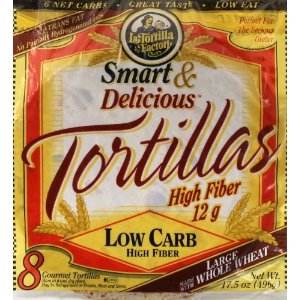
Trader Joe’s Sonoma Low-carb tortillas.

traderjoetortilla

This is an example of low-carb tortillas.  this one is at Costco and Markets.

tortillasmart


The Skinny on Mexican Food

Recently. I read that almost 33 percent of Mexicans are obese, making it the most obese nation in the world,

We have a huge population of people in the U.S., who are also obese and eat Mexican food. So, is Mexican food fattening?

The issue is that due to high prices in Mexico, the regular population cannot afford the vegetables and fruit, so they stick to the American Junk food items (hamburgers, soda, pizza) and the cheaper Mexican meals.

Mexicans wryly call their foods of choice, “Vitamin T”–the tacos, tamales and tostadas. These foods anchor their diet and are much of the problem. Once reserved for special occasions, the carbohydrate and lard-loaded dishes now get gobbled daily.

That wasn’t so much a problem in past generations, when most Mexicans lived on the land, worked hard physical labor and couldn’t afford a daily feast. These heavy carved foods are not meant for daily consumption. And the more sedentary lifestyles, combined with the ability to eat as if it were a party most days, has helped lead to the country’s girth growth.

There are plenty of healthier choices like broth-based soups, fresh fish, salads, vegetables and fruits. But those tend to be more expensive for the Mexican poor and working class. And the heavier fare is just so good and addictive. Carbs are addictive.

People who eat Mexican food this way on America are also facing a weight challenge.

I went to a Mexican restaurant recently, after being afraid to eat Mexican food and I ordered a grilled chicken salad. It was delicious. Lettuce, guacamole, cheese, tomato and seasoned grilled chicken–served with a guacamole dressing. I am pretty site my meals was under 10g of carbs, compared to a burrito with the heavily-carbed rice and beans, at 50 or 60g of carbs.

My salad was tasty, filling and I will stay thin with it. I don’t want to go over 100g of carbs a day. This is the right way to eat and even the old school thinner Mexican way to eat. We need to learn that we can’t eat party style every day. We need to eat right and only eat Vitamin T on special occasions.

20130924-003500.jpg

Eating the Coconut Squares Is A NoNo!

A client of mine went to Trader Joes before coming into my office. Her friend came with her and had a bag of Trader Joe’s lightly sweetened coconut strips.

20130919-225720.jpg

The friend offered me some, telling me that she had been eating them and that they are delicious. Apparently, she does not read my blog.

Here Are The Issues

1. A coconut is a fruit, a fruit high in carbs.
2. It is sweetened. Always go for unsweetened.
3. Fruits should be natural, no sugar added and eaten in measured amounts, knowing the carb amount.

I took the bag and looked. 1/4 a cup was a total of 24 grams of carbs. 6g of fiber is good, but only 2 grams of protein (you should be eating MORE protein, less sugar). It also had 16g of sugar, or approximately 4 sugar cubes per 1/4 a cup. And 1/4 a cup is teeny!

Guaranteed, that this lady had no knowledge or desire to know what she was eating. The only real concern was hunger and taste. “This tastes so good.”

I am going to guess that this lady either had no breakfast or ate a little carby food item before venturing out with her friend, causing her to have a sugar roller coaster affect, and a major sugar low and a need for something sweet (more of the hair of the dog that bit her). And what a shame too. She is getting over a major illness and should be focused on eating right, not eating sugary coconut strips.

Issue 4.

Just because Trader Joes or Whole Foods sells an item, it doesn’t mean that you should eat it, that it is good for you, or you will lose weight.

What To Eat When You Are Hungry

I have discussed substitute snacks many times. A snack between each meal and after dinner. They should all be protein based, low sugar. If not dairy products cheese, cottage cheese, etc) eggs, or meat. There is also low-sugar protein bars or protein drinks, low-sugar or carb Greek Yogurt, measured out nuts or peanut or almond butter. If you have a piece of fruit, eat a natural one, not dried and a small piece mixed with some form of protein, your body will feel full longer with protein, not sugary fruit alone.

Sugar-Free and Tasty Granola

A lot of people complain that if they have oatmeal or Greek yogurt, that it is a bit too bland for them. I tell them that they can put one of their two daily small servings of fruit in their yogurt or oatmeal. You can also use nuts, bit read the nutrition label for the carb count per serving size. But, some people want granola. Granola is a no-no as a healthy diet or maintenance food.

Many people think that granola is a health food. Well, with all of the sugar in regular granola, you will wind up gaining weight with it. But, there is a recipe for sugar-free granola. This sugar-free recipe has 4g of net carbs per half a cup. granola has about 32g of carbs, 6g of fiber (26g net carbs) and 5g of protein, and 12g of sugar–which is like eating three sugar cubes.

So, I decided to try a sugar-free type of granola. It wasn’t hard to make.

This recipe has no fruit. I hate fruit in my nuts. But, if you want to throw in a few raisins, go ahead, but keep it to a minimum. Raisins are high in sugar and carbs. A half a cup of raisins is 66g of carbs and 48g of sugar or 12 sugar cubes. Seriously! Just half a cup of them! Dried fruit is a weight gainer!

So, feel free to substitute any nuts or seeds you like in this recipe, but the flax meal is essential, and the coconut is helpful. These will absorb the liquids and this is what will form the clumps — otherwise you just have toasted nuts and seeds with some flavoring.

Yield: 12 Servings

Ingredients:

  • 1 cup raw almonds
  • 1 cup raw walnuts
  • 1 cup raw pecans
  • 1 cup shredded coconut, unsweetened
  • 1/2 cup sunflower seeds
  • 1/2 cup flax seed meal
  • 1/2 teaspoon salt
  • 1/2 cup water
  • 1/2 cup butter or coconut oil
  • 1/2 cup sugar-free maple-flavored syrup

Preparation:


1. Heat oven to 300 F. Cover baking sheet with sides with a silicon mat or greased parchment paper.

2. Roughly chop the nuts.

You can do this in a food processor, but if you do, start with the harder nuts — the almonds in this recipe or filberts (hazelnuts) if you use them. \
3. Melt the butter or coconut oil – you can microwave it in the bowl you’re going to use for mixing (although you can mix right on the baking sheet), if you wish.

4. Mix the syrup and coconut oil or butter together.

5. Combine the nuts, coconut, seeds, and salt. If you’re doing this on the baking sheet, add the water first and mix (hands work best), and then the oil/butter and syrup mixture. Otherwise, just combine it all in a bowl and turn out onto the baking sheet. Press into an even layer.

6. At this point, it’s good to taste it. It’s going to end up tasting a little less sweet, so judge your own desire for sweetness and add more if you want.

7. Bake for 30-40 minutes. Twice during the baking, stir the mixture with a large spoon and press back down. After the second time, don’t move it around any more. Bake until fragrant and lightly browned on the surface.

8. Let cool completely in pan. It will crisp as it cools. Store in sealed container. Serve with yogurt, cottage cheese, etc. If you like, add dehyrdrated blueberries or strawberries.

Make about 6 cups — 12 servings. (half a cup servings)

Nutritional Information: Each serving has 4 grams net carbs plus 6 grams fiber (10 grams total carbohydrate), 7 grams protein, and 292 calories.

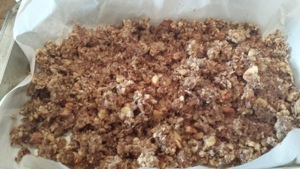
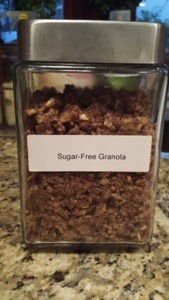
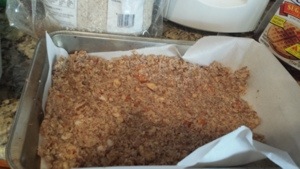
Here are the pictures that I took of the process from the mix, to on the sheets, cooked and put in the jar.

20130916-212940.jpg

20130916-213009.jpg

20130916-213031.jpg

20130916-213107.jpg

20130916-213309.jpg

20130916-213337.jpg

20130916-213514.jpg

What Kind of Carb-Eating Dieter Are You??

I had a conversation today with a lady who wants to eat well and keep her weight down, and she thinks you have to eat all carbs in the morning.  I realized how many people really have no idea what is good for a diet or not.

Myth:  You have to eat toast or some kind of grain at breakfast because you need carbs for energy.

Here is the deal.  You need protein!  You get little protein in bread.  Eggs, meat, dairy, nuts, yogurt–they have protein.  Bread is low on the list.  Also,  I told her that I had some fruit with my eggs in the morning and she seemed to not realize that fruit has carbs.  So, to have fruit and bread–I know my body.  It does need so many carbs at once.  Her philosophy, have carbs earlier in the day and little to none later.

Is she right?  Yes and no.

Why?  It depends on your body.  Everyone is different.  Here are some rule of thumbs on carbs throughout the day.   Everyone has a different body type and there is no set rule of thumb for everyone.  Which of these five Carber-types are you?  Are you a late night carber, morning carber, day faster and later one meal carber, few carbs per meal carber or a post-workout carber?

carb eater

1.  THE LATE NIGHT CARBER:

  • Questions: Workout at night? Have diffulty sleeping? Crave starch, salt and/or sweets in the evening? Find yourself ravenously hungry in the morning?

Answer:  If so, save your entire days carb intake for the evening.  If you notice you sleep better and your hunger, energy, and cravings are better controlled the next day AND the end of the week shows improvement in body composition, you have moved one step closer to your metaboloic needs.

2.  THE MORNING CARBER:

  • Questions:  Workout in the morning before eating? Crave coffee and pastries for breakfast? Notice low energy all day if you don’t have morning carbs? Find yourself insatiably hungry at night?

Answer:  Then eat all your carbs in the morning, and skip them the rest of the day.

3.  THE DAY FASTER, LATER ONE-MEAL CARBER:

  • Questions:  Don’t feel hungry for most of the day until after lunch? Have high energy despite not eating? Tend to hold onto your muscle mass?  Get sick and tired of worrying about preparing meals for the day and stressing about what to eat? Are able to go the whole day without food and still eat sensibly at night?

Answer:  Then, consider fasting the entire day and eating only one big meal (including the carbs) in the evening.

4.  THE FEW CARBS PER MEAL CARBER:

  • Questions:  Feel low energy when you don’t eat? Get a foggy head and can’t think clearly unless you have carbs? Are you insulin resistant and tend to “feel hypoglycemic”? Overweight or obese? New to the fat loss lifestyle? Then you will likely be better off eating small frequent meals with each meal containing small amount of carbs (5 to 10 bites).  (THIS IS ME)

Answer:  These meals should also be accompanied with a good portion of protein.

5.  THE POST-WORKOUT CARBER:

  • Questions:  Have difficulty gaining muscle? Train intensely with weights? Having difficulty recovering from exercise? Are an athlete with performance goals?

Answer:  Then eat carbs post-workout as well. 30 to 50g whey protein and a large banana may give you just the right insulin kick at just the right time to take your fat burning and muscle-building game to the next level.


So, figure out what kind of carber you are and work with it.  Take your diet to a whole new level, based on your body’s needs!

11 Steps to Help Lose and Manage Your Weight


11 Steps you Can Take to Lose and Manage Your Weight:

measure

  1. Build more lean muscle.   Muscle has a higher metabolism than fat does, so you want to work out and lose fat, gain lean muscle. Add weights to your exercise program.
  2. Fight off hunger with foods with fiber.  “Keeping that feeling of fullness can be done with foods with fiber— think fruits and vegetables, low-carb whole grains, and lean protein.
  3. Avoid temptation and plan ahead with foods at home and if you go out to eat.  There are many ways to avoid daily temptations, including planning ahead when eating out, eating out less, and banning your worst weaknesses from the house.
  4. Count calories. Use a journal such as My Calorie Counter to keep a running total throughout the day if that helps you keeps track of calorie consumption.
  5. Plan your meals in advance. A maintenance diet has a lot of the same components as a weight-loss diet. Having a meal-by-meal plan that you can stick to, although it has more calories than your diet plan did, can act as a guide to keep you on track.  I shop once a week with meals in mind for the week and plan my foods.  I always have Greek Yogurt, nuts, low-fat cheese, eggs and egg substitutes, low-carb pancake mix and syrup, salad mix, turkey slices, chicken breasts and bacon in the house.
  6. Consider adding minutes to your exercise plan. Experts recommend at least 30 minutes of physical activity five days a week, but emphasize that the more you exercise, the better able you are to maintain a weight loss. Participants in the weight control survey walked for at least 60 minutes daily — or burned the same calories with other activities — so aim for 60 to 90 minutes of physical activity every day.
  7. a. Measure your portions. A huge factor in weight loss success is  measuring portions of proteins and fats, the most caloric foods, in particular. This doesn’t mean you have to carry a food scale everywhere you go, but using it as often as possible at home will teach you how to eyeball portion sizes at restaurants and immediately know how much to eat, and how much to have as to-go.                              b.Let your plate be your guide. First off, use smaller plates.  this helps you to control how big your portions are.  When you can’t count calories or measure portions accurately,  A great tip for dieters, it works just as well for people on a maintenance plan– when you serve yourself using the Plate Method, at least half your plate should be vegetables and the remaining space should be divided evenly between lean protein and whole grains. If you go back for seconds, limit yourself to vegetables, fruit or low-fat dairy.
  8. Weigh yourself daily. You will be more successful in losing weight if you weigh yourself daily. Daily weigh-ins, which can be discouraging when you’re on a diet, can be a boon during maintenance; they let you see, and stop, any slow creep upward as soon as it happens.
  9. Include dairy in your diet.   Women in particular, this has the additional benefit of improving bone health.   However, low-fat dairy helps to fight of hunger pangs.
  10. Watch less TV. Dieters who watch fewer than 10 hours of TV a week were more successful in maintaining weight loss than those who spent more time vegging out in front of the tube.
  11. Eat breakfast. They call it the most important meal of the day for a reason. In the survey, women who regularly ate breakfast were more successful with long-term weight loss than those who skipped the first meal of the day. 


Vegetarians Can Do Low-Carb Diets TOO

A Skinny-Rules reader asked a good question about what to do as a vegetarian!  Thank you for this question!

The Skinny-Rules follows mostly a Paleo diet, but it is basically a high-protein, low carb diet.  So, this can be done as a vegetarian.

protein

Being a vegetarian is a sticky issue with weight loss.   You have to eat veggies that are lower on the carb scale. Here is a site that shows vegetables from lowest to high in the carbs.

http://lowcarbdiets.about.com/od/whattoeat/a/whatveg.htm

Also, remember that starches that grow underground have a lot of sugar/starch. And stick with vegetables highest in protein, like broccoli and spinach.

http://www.healthaliciousness.com/articles/vegetables-high-in-protein.php.

Watch soy. It is genetically modified. ALL of it. You can have beans, but watch the carb content.

GREAT SOURCES OF PROTEIN FOR VEGETARIANS:

  • A good protein for vegetarian is eggs.  6g of protein per egg and less than 1g of carbs per egg.
  • Another good source is Greek Yogurt at about 18g of protein per 6 oz, lower in carbs.  Also, UNSWEETENED almond milk is low in carbs (less than 1g of carbs per cup, but only 1g of protein…but still lower in carbs than milk.
  • Cheese is a good source of protein (low-fat).  A skinny cheese stick is about 6 grams of protein, and only 1g of carb.
  • Nuts are high in carbs, but also high in protein.  Just count out what you are eating.  For example, a cup of almonds is 20g of carbs, but it is also 20g of protein.  You have to read labels.
  •  Look at almond butter, etc– as well.  2 tablespoons is 6g of carbs and 7g of protein.
  • Low-carb protein shakes and bars, as I have blogged about many times.   Trader Joes and other health food stores carry protein powder to put into shakes.
  • Trader Joes has a low carb, high protein shake that I recommend.  Vanilla or Chocolate with a whopping 35g of protein and only 4g of carbs.  This is a GREAT way to get in your needed protein.

pure-protein-shake

Everyone is different in their protein needs.  For someone my size, I need about 43-97g of protein per day.  You can calculate your own needs with an online calculator.

http://lowcarbdiets.about.com/library/blproteincalculators.htm

So, learn about what foods are high in proteins and make sure you get them daily.  I would think that if you had Egg Beaters or egg whites mixed in with regular eggs (Egg Beaters 3 tbsp is 5g of protein, less than 1g of carbs)….you could make a nice spinach and low-fat cheese omelette and get a lot of protein in that.  In a small omelette, you can get about 13 grams of protein and only a few carbs.

Remember:  The meat-eater has to eat 6 times a day, every 3-4 hours to keep the metabolism going.  The vegetarian might have to do it even more often to keep up with the need of protein to keep the metabolism going.

Eating Too Much or Too Little Food Can Mess Up Your Waistline and Brain

If you are not eating a balanced diet, it can affect your brain, as well as your waistline.

brainfood
1. No Breakfast

People who do not eat breakfast are going to have a lower blood sugar level.  This not only messes up your metabolism, but this leads to an insufficient supply of nutrients to the brain causing brain degeneration.

2. Overeating

It fat deposits, and it causes hardening of the brain arteries, leading to a decrease in mental power.


3. High Sugar Consumption

Too much sugar will put on fat and interrupt the absorption of proteins and nutrients causing malnutrition and may interfere with brain development.

Time to Eat Some Chocolate Cake and NOT Gain Weight!

I am reposting a great, quick and easy LOW carb chocolate cake  that I had put up before.  I made these again tonight (makes for 4 small chocolate cakes in mugs).

Dr. Oz had a guest, who spoke about the importance of low sugar in a diet.  Jorge Cruise has great recipes on his site, Jorgecruise.com.  But, he has a recipe for no-sugar, low-calorie chocolate cake.  It is small, it is quick and you cook it in the microwave for 60 seconds.  So, I tried it and even my husband liked it.  I recommend it for those with a sweet or chocolate tooth!

finished-cake

1 minute chocolate cake recipe:

1/4 cup Truvia Baking Blend

1.2 cup almond flour

3 tablespoons unsweetend cocoa powder

1/8 teaspoon baking powder

1/2  teaspoon baking soda

1/4 teaspoon salt

2 tablespoons coconut oil

1 egg

2 tablespoons half and half

DIRECTIONS:

Mix all ingredients in a bowl, mix, pour 1/4 of mixture into a mug (can make 4 mugs, filled up about 1/5 of each cup because it expands).  Cook mug  in microwave for 60 seconds.

trim a little around the edge of the mug and then pour out onto a plate.  Then put whip cream on top.

Here are pictures of the process.  I would say there is about 2-3g of carbs in this little delicacy for the day!

The pics are posted on my blog:  https://skinny-rules.com/2013/05/28/you-can-have-your-cake-and-eat-it-too/